
Wear & Friction Testing
/ analyses & testing /
Tribology: Wear Testing
& Friction Measurement
The tribology platform of CRITT MATÉRIAUX INNOVATION allows the evaluation of wear and friction properties of materials and finished products for various fields of activity. Our equipment covers surface scratch resistance analysis (micro and nano scratch-test), abrasion resistance (Taber), friction and wear coefficient measurement (standard pin-on-disc tribometers, high temperature, high loads), and joint implant wear simulation (hips, knees).
State-of-the-art equipment for tribological analysis
Our tribology platform has specialized equipment to characterize the tribological behavior of your materials, coatings and assemblies under various conditions.
- Micro and nano scratch-tests
- Taber® abrasimeter (ISO 7784-2, ASTM D 4060)
- Pin-on-disc tribometers (1 to 500 N)
- High temperature tribometer (up to 800°C)
- High load tribometer (ASTM F732)
- Joint implant wear simulators (ISO 14242/14243)
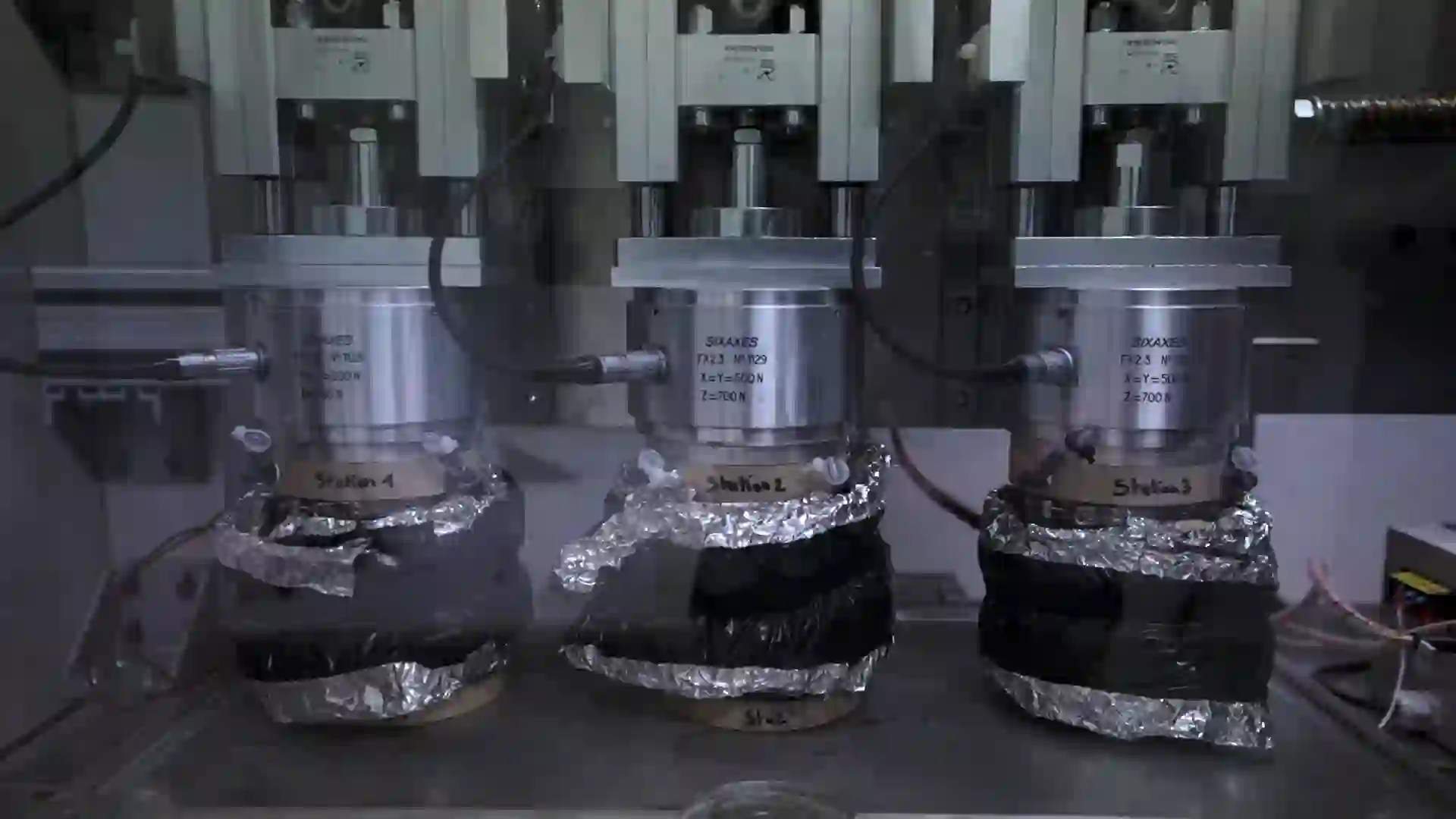
Tribological equipment and capabilities
Our equipment allows the evaluation of tribological behavior of metallic, polymer, ceramic, glass materials, coatings and surface treatments under various conditions: ambient air, liquid medium, lubricated, high temperature, high loads.
- Micro-scratch test : instrumented scratch test for analysis of thin film resistance and their adhesion level to substrate at micrometric scale. Determination of indenter penetration depths under load and residual.
- Nano-scratch test : scratch resistance and thin film adhesion analysis at nanometric scale. Abrasive wear by multiple indenter passes.
- Taber® abrasimeter : surface abrasion resistance test according to ISO 7784-2, ASTM D 4060, ASTM F 1978 standards. Measurement of mass loss or appearance change after abrasion cycles with standardized wheels.
- Conventional pin-on-disc tribometer : ASTM G99 compliant. Continuous friction coefficient measurement. Wear tests under ambient air, liquid or lubricated medium. Load from 1 to 20 N. Wear evaluation by weighing, groove areas, SEM observations.
- High temperature tribometer : temperature up to 800°C. Load from 1 to 20 N. Maximum speed 500 rpm. Rotary / alternating rotary mode. Fretting test possible. Allows highlighting the impact of oxide layers formed on surface, their lubricating properties and disintegration kinetics.
- Multidirectional high load tribometer (3 stations) : 3 simultaneous stations with independent load. Multidirectional trajectories (x, y displacements). High loads up to 500 N. ASTM F 732 compliant. Allows stressing polymer materials more realistically by generating shear stresses.
- Joint implant wear simulators : hips, knees according to ISO 14242 & 14243 standards. Physiological walking cycle simulation. Gravimetric and volumetric wear measurement.
Our tribology approach
Our tribological studies are based on rigorous methodology and specialized equipment. Each tribological project follows a structured protocol in 3 complementary steps for complete characterization:
Tribological need analysis
Study of your wear or friction problem. Identification of materials in contact, operating conditions (load, speed, temperature, lubrication). Choice of appropriate tribometer and test protocol definition. Selection of applicable standards (ASTM G99, F 732, ISO 7784...)
Tribological test execution
Sample preparation and initial surface condition control (roughness, profilometry). Tribometer mounting and adjustment. Wear tests with continuous friction coefficient recording. Specific environments: high temperature, lubricated medium, high load. In-situ observations if possible.
Post-test characterization and report
Wear measurement by gravimetric weighing and groove volumetric analysis. SEM-EDS observations of surfaces and wear facies. 3D profilometry and roughness measurement. Identification of wear mechanisms (abrasion, adhesion, transfer...). Detailed report with curves, images, interpretation.
Application example: SMAT Treatment
Evaluation of a surface treatment "SMAT: Surface Mechanical Attrition Treatment" on scratch resistance of CoCrMo (CCM) material and wear of a CCM/UHMWPE couple, used in hip prostheses:
 CCM micro-scratch analysis
Scratch resistance test (Scratch-test)
Testing : Instrumented scratch tests on CoCrMo (CCM) samples with and without SMAT treatment. Measurement of indenter penetration depth, film critical failure force, friction coefficient. SEM observations of scratch traces. Comparative analysis of damage mechanisms.
Pin-on-disc tribometer
Wear tests on CCM/UHMWPE couple
Testing : Tribological tests on CoCrMo (disc) / UHMWPE polyethylene (pin) couple with and without SMAT treatment of CCM. Lubricated medium (physiological serum). Friction coefficient measurement. UHMWPE antagonist mass loss evaluation by weighing. Wear groove analysis.
SEM-EDS & Profilometry
Post-test characterization
Testing : SEM observations of surfaces after tribological tests. EDS mapping for identification of wear products and transfer mechanisms. 3D profilometry of wear grooves for volumetric quantification. Comparative roughness analysis before/after tests.
Your Questions, Our Answers
Tribology is the science that studies friction, wear and lubrication between two surfaces in contact and in relative motion. It is crucial for the durability and performance of many mechanical systems: joint prostheses, bearings, gears, anti-wear coatings, cutting tools, etc. Poor tribological performance can lead to premature failures, loss of energy efficiency and high maintenance costs.
We test all types of materials: metals and alloys (steels, stainless steels, cobalt-chromium alloys, titanium, aluminum...), polymers (UHMWPE, PEEK, PTFE, PA...), ceramics (alumina, zirconia, carbides...), glasses, composites, coatings (DLC, nitriding, PVD, CVD...), surface treatments. Our tests adapt to the specific properties of each material.
The scratch-test evaluates scratch resistance and adhesion of a coating or thin film by sliding an indenter under increasing load. It is used for thin layers (< 50 µm). The tribological wear test (pin-on-disc tribometer for example) simulates real friction conditions over long durations to measure the friction coefficient and quantify volumetric wear. Both approaches are complementary.
Yes, our high temperature tribometer allows tests up to 800°C under loads from 1 to 20 N. This is particularly useful for evaluating tribological behavior of materials for high temperature applications (aeronautics, energy, automotive...) and highlighting the impact of oxide layers formed on surface, their lubricating properties and disintegration kinetics.
The ASTM F 732 standard defines wear test methods for polymer materials used in joint prostheses. Our 3-station multidirectional tribometer meets these specifications with loads up to 500 N and multidirectional trajectories (x, y). It allows stressing materials more realistically by generating shear stresses, important for orthopedic implants (UHMWPE in particular).
Yes, we have joint implant wear simulators (hips, knees) compliant with ISO 14242 & 14243 standards. These simulators reproduce physiological walking cycles and allow gravimetric and volumetric wear measurement on real material couples (CoCrMo/UHMWPE, ceramic/UHMWPE, ceramic/ceramic...) under conditions close to in-vivo conditions.