
Mechanical Testing
/ analyses & testing /
Static & Dynamic
Mechanical Testing
The mechanical testing laboratory of CRITT MATÉRIAUX INNOVATION has a machine fleet allowing a wide range of tests, according to existing standards or according to a protocol adapted to your needs. We can design and manufacture specific fixtures adapted to parts or custom test protocols, in specific environments (temperature, liquid medium...).
Wide range of mechanical tests
Our equipment fleet allows static and dynamic tests over a very wide force range, from 1.25 N to 240,000 N, with standard or specific fixtures designed for your parts.
- Tensile and compression (1.25 to 240,000 N)
- Torsion (0.1 to 100 N.m)
- Combined axial/torsion tests
- Point bending and rotary bending
- Screwing tests (up to ±16 turns)
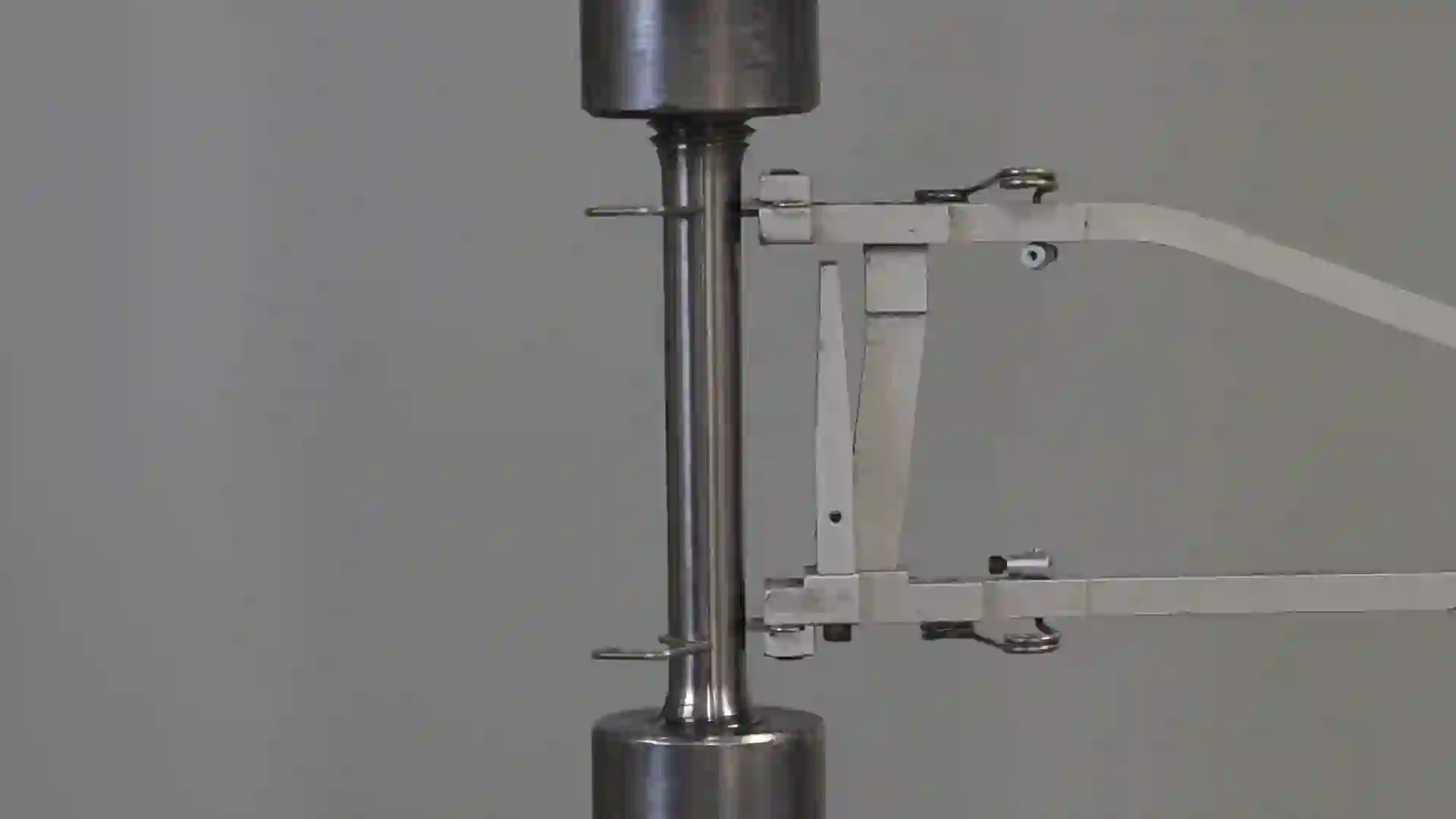
Test capacities and equipment
Our mechanical testing laboratory is equipped with universal and specialized testing machines to characterize the mechanical behavior of your materials, components and assemblies according to international standards or specific protocols.
- Uniaxial tensile tests : mechanical properties characterization (Re, Rm, Rp02, A%, E), tests on standardized specimens or real parts, ambient or controlled temperature
- Compression tests : compression strength, tests on bulk materials or assemblies, specimens or finished parts.
- Torsion tests : torsion torque, angle at break, torsional stiffness, screwing and disassembly tests
- Fatigue tests : low-cycle and high-cycle fatigue, alternating tension-compression, rotary bending, fatigue under mean stress
- Bending tests : 3-point and 4-point bending, impact bending, flexural modulus
- Shear tests : shear strength, pure or combined shear behavior
- Combined axial/torsion tests : multiaxial loading, complex loads, real condition simulation
- Impaction tests : instrumented impact tests, absorbed energy, resilience
- Specific fixtures : design and manufacture of fixtures adapted to your parts (lifting hooks, medical implants, screwed assemblies, intervertebral cages...)
Our mechanical testing approach
Our mechanical tests are based on rigorous methodology and calibrated equipment. Each test campaign follows a structured protocol in 3 complementary steps to ensure reliable and traceable results:
Test protocol definition
Analysis of your needs and technical constraints. Selection of applicable standard (ISO, ASTM, EN...) or definition of a specific protocol. Design of adapted test fixtures if necessary. Validation of parameters: forces, displacements, speeds, temperatures, number of samples.
Test execution
Specimen preparation and dimensional control. Mounting on testing machine with adapted tooling. Test execution with continuous data acquisition (force, displacement, strain, time). Systematic metrological control. Specific environments if necessary (temperature, liquid medium).
Analysis and test report
Force-displacement curve exploitation. Mechanical properties calculation: Re, Rm, E, A%, Z%, hardness... Statistical analysis of results. Issue of test report compliant with standards with curves, results, photos, interpretation. COFRAC accreditation if applicable.
Application examples
 Metallic material qualification
Tensile tests on standardized specimen
Testing : Uniaxial tensile tests according to ISO 6892-1 or ASTM E8 on cylindrical or flat specimens. Determination of yield strength Rp02, tensile strength Rm, elongation at break A%, reduction of area Z%, Young's modulus E.
Service life validation
Fatigue tests on lifting hooks
Testing : Uniaxial tension-tension fatigue tests on real hooks mounted on 100 kN testing machine. Application of variable load cycles from 10% to 90% of maximum working load (MWL). Recording of number of cycles to failure.
Medical device - Spine
Impaction tests on intervertebral cage
Testing : Impaction tests according to specific protocol on carbon-reinforced PEEK interbody cage. Measurement of impaction resistance, displacement under load, structural integrity after loading. Post-test observation by imaging and microscopy.
Your Questions, Our Answers
We perform a wide range of mechanical tests: tensile/compression (1.25 to 240,000 N), torsion (0.1 to 100 N.m), fatigue (low-cycle and high-cycle), bending (3 or 4 point, impact, rotary), shear, combined axial/torsion tests, screwing tests (up to ±16 turns), impaction. These tests can be performed according to standards (ISO, ASTM, EN...) or specific protocols adapted to your needs.
We test both standardized specimens and real parts or complete assemblies. Our strength is precisely our ability to design and manufacture specific fixtures adapted to your parts: lifting hooks, medical implants (femoral stems, intervertebral cages), screwed assemblies, automotive or aeronautical components... Each fixture is designed to best reproduce real-use conditions.
Yes, a large part of our mechanical tests can be performed under COFRAC accreditation (NF EN ISO/IEC 17025), NADCAP, AIRBUS or SAFRAN accreditation. Consult our COFRAC accreditation scope for the detailed list of accredited tests. Accreditation guarantees metrological traceability, technical competence and international recognition of our results.
Yes, some tests can be performed in a specific environment: controlled temperature (from -196°C with liquid nitrogen to +1000°C with furnace), liquid medium (corrosive, lubricated, water, oil...), controlled atmosphere (vacuum, inert gas...). We have climatic chambers and thermal enclosures adaptable to our testing machines. Contact us to validate the technical feasibility of your need.
Turnaround times vary depending on the type and complexity of tests. For standard tests (tensile on standardized specimens), allow 5 to 10 working days. For fatigue tests (several hundred thousand cycles), allow 2 to 4 weeks depending on cycle duration or more if there are many specimens to test. For specific fixtures requiring design and manufacture, allow 4 to 6 weeks. Express turnaround times are possible depending on urgency and machine availability.
Absolutely! Our mechanical engineers support you in defining the most suitable test protocol for your problem: choice of applicable standard, definition of loading parameters (forces, displacements, speeds, frequencies...), number of samples, acceptance criteria, statistical analysis of results. We can also perform a preliminary feasibility study if necessary.