
Cleanliness Control
/ characterizations & controls /
Residue Analysis for Medical Device Cleaning Validation
CRITT MATÉRIAUX INNOVATION supports you in validating the cleaning of your medical devices according to the specificities and constraints of your devices: type of material used (metal, polymer or ceramic), manufacturing process, sterilization method. Our laboratory has the equipment and expertise needed to detect and quantify organic, inorganic and particulate residues that could compromise sterilization and safety of your devices. Most of these tests are performed under COFRAC accreditation (NF EN ISO/IEC 17025).
Residue Analysis
Our laboratory performs residue analysis in accordance with ISO 19227:2018 (Surgical implants - Cleanliness of orthopedic implants - General requirements) to detect and quantify:
- Total Hydrocarbons (THC)
- Total Organic Carbon (TOC)
- Inorganic residues
- Particulate contamination (non-soluble and non-embedded contaminants)
- Embedded non-soluble contaminants
- Corundum incrustation rate measurement
Types of Residue Analysis
Our laboratory has recent and high-performance analytical equipment required to detect and quantify residues that may remain after cleaning and finishing processes of medical devices.
- Total Hydrocarbon (THC) residue analysis : by gas chromatography (GC) to detect residues from oil, polishing paste grease base, lubricant, industrial greases. Method for quantifying a global index of organic contamination soluble in non-polar or semi-polar solvents.
- Total Organic Carbon (TOC) residue analysis : by TOC analyzer to detect residues from organic detergents, fatty alcohols, detergents, rinsing agents. Method for quantifying a global index of organic contamination soluble in polar solvents (ultrapure water).
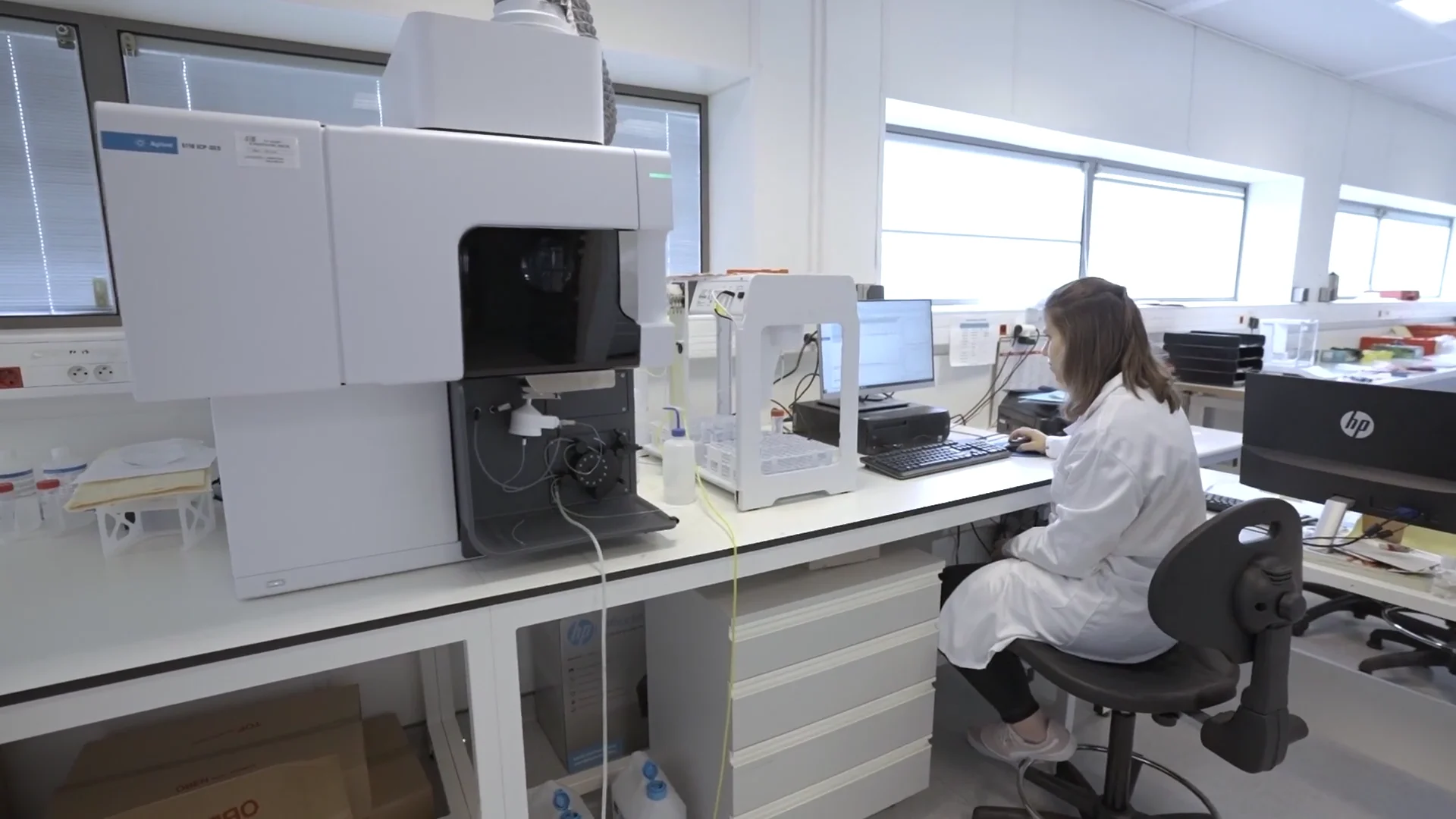
- Inorganic residue analysis : analysis of water-soluble inorganic tracers, according to targeted elements involved in the manufacturing process: detergent residues (e.g. Na, K, P, Si, Ca), heavy metal residues and soluble metallic salts (e.g. As, Cd, Hg, Pb, Fe, Zn, ...) by ICP-OES analysis; and ionic residues from inorganic acids (e.g. NO₃⁻, F⁻, Cl⁻, SO₄²⁻) by ion chromatography.
- Embedded non-soluble contaminant analysis : detection and characterization of corundum particles, polishing paste, glass beads, metallic particles. Microscopic observations (SEM-EDS), image analysis, surface quantification. Critical for implantable devices.
- Corundum incrustation rate measurement : evaluation of the percentage of contaminated surface by optical microscopy and SEM. Determination of the proportion of ceramic phases on the surface by X-ray diffraction (XRD). Chemical mapping by SEM-EDS for precise localization.
- Particulate cleanliness control : particle counting and identification according to ISO 14644 and ISO 14698. Cleanliness classification according to specific standards (IEST-STD-CC1246, VDA 19...). Analysis of residual contamination after cleaning.
Our approach for residue analysis in cleaning validation
Our residue analysis tests for cleaning validation follow a methodology based on a 3-step structured protocol to ensure the compliance of your devices:
Customer support for selecting analyses
Analysis of SDS sheets for products involved in the process to identify possible tracers to characterize any manufacturing residues present.
Sampling and analysis
Sampling by direct method (ultrapure water rinse, solvent...) or indirect (swabbing). Solid-liquid extraction on medical devices by immersion in solvents under ultrasound. Multi-technique analyses: GC (THC), TOC analyzer, ICP-OES and/or ion chromatography (inorganics), optical microscopy and SEM-EDS (particles), XRD (corundums). Analytical quality control with blanks and certified standards. Complete sample traceability.
Validation and compliance report
Compilation of analysis results with measurement uncertainties. Comparison with pre-established acceptance limits by the customer. Detailed report with compliance statement. COFRAC accreditation available.
Examples of residue analysis performed
 Titanium dental implants
Initial cleaning validation of titanium dental implants after machining and pickling
Service performed : Analysis of safety data sheets for products involved in the process to identify possible tracers. Search for machining oil residues (THC), detergents used for cleaning (TOC, inorganic salts Na and K) and inorganic acids (F⁻ and NO₃⁻). Analyses performed on 3 samples per batch (QOmin, QOmax, QP1, QP2, QP3 lots) after validation of extraction method exhaustivity on QOmin and max.
Orthopedic implants
Periodic monitoring of cleaning process on orthopedic implants
Service performed : THC and TOC residue analysis used as a global contamination index for process monitoring. Tests performed on 3 samples taken monthly by the manufacturer from a representative worst-case production batch.
Your questions, our answers
Cleaning validation is a critical regulatory requirement (ISO 19227, ISO 10993-18, ISO 10993-12, etc.). Manufacturing residues (oils, polishing pastes, cleaning agents, metallic or ceramic particles) can compromise biocompatibility, interfere with sterilization, and cause inflammatory or toxic reactions in patients. Validation proves that your cleaning process systematically and reproducibly eliminates these contaminants to safe levels.
We analyze 5 main categories of residues: 1) Total hydrocarbons (THC) from oils, greases, lubricants, 2) Total organic carbon (TOC) from detergents and cleaning agents, 3) Inorganic residues (Na, K, P, Si, Ca, NO₃⁻, F⁻, Cl⁻, SO₄²⁻, etc.) from acids, bases, salts, 4) Toxic heavy metals (Cd, As, Hg, Pb) and soluble metallic traces (Fe, Cr, Ni...), 5) Non-soluble particulate contaminants (corundum, glass beads, embedded polishing paste). Each type requires a specific analytical technique.
Yes, a large part of our residue analysis for cleaning validation can be performed under COFRAC accreditation (NF EN ISO/IEC 17025). This includes THC, TOC dosing, inorganic residue analysis most commonly encountered in medical device processes, by ICP-OES (Na, K, P, Si, Ca) and ion chromatography (NO₃⁻, F⁻, Cl⁻, SO₄²⁻). COFRAC accreditation guarantees technical competence, metrological traceability and international recognition of our results, essential for FDA, CE audits and notified body inspections.
Corundum incrustation rate (abrasive particles used for sandblasting or polishing) is measured by several complementary techniques: 1) Optical microscopy with image analysis to quantify the percentage of contaminated surface, 2) SEM-EDS to chemically identify particles (Al₂O₃) and map their distribution, 3) X-ray diffraction (XRD) to determine the proportion of ceramic phases on the surface, 4) Concentration profiles to evaluate incrustation depth. This control is critical for orthopedic implants (risk of premature wear and debris release).
Lead times vary depending on the number and type of analyses: for example, for a complete analysis (THC, TOC, inorganics) on 3 samples, allow approximately 1 week. For particulate contamination, allow a few additional days. Express delivery is possible depending on urgency. Contact us to plan your project.